
Machine Learning
<- Return to all blogs
-
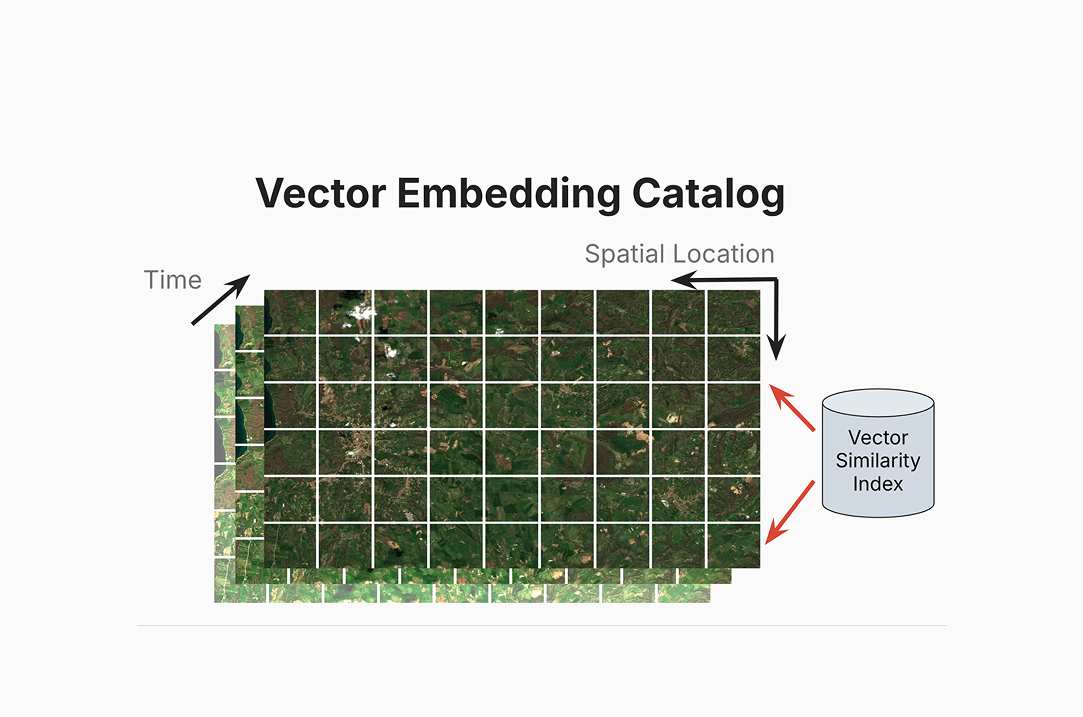
Why We’re Talking About a Centralized Vector Embeddings Catalog Now
We discuss our detailed white paper in which we make the case for how Earth Observation (EO) data providers such as NASA can dramatically improve access to their data by creating a centralized vector embeddings catalog, in addition to the more standard data catalogs that they already maintain.
-
Why We’re Talking About a Centralized Vector Embeddings Catalog Now
We discuss our detailed white paper in which we make the case for how Earth Observation (EO) data providers such as NASA can dramatically improve access to their data by creating a centralized vector embeddings catalog, in addition to the more standard data catalogs that they already maintain.
-
Prioritizing Responsible AI
AI is moving fast. It’s moving faster than we can govern and regulate it, and even sometimes faster than our understanding of its full impact. As we push the boundaries of what AI can do, everyone is scrambling to keep up. Thus, the guidance and governance around AI usage are still evolving. In this time…

-
Generating truly useful solutions to real problems with the help of user experience and AI
We discuss how AI and user experience methodologies might serve to connect scientists and researchers back to important data and technology to solve the world’s biggest problems.

-
The State of Geospatial AI Heading into 2025
For the second year in a row, I spent the week after Thanksgiving in Las Vegas, immersed in AWS re:Invent. Last year’s conference left me energized and inspired— geospatial AI was just beginning to emerge as a transformative force. This year, as anticipated, AI took center stage, with a wealth of sessions dedicated to its…

-
Finding Changes on the Earth with Natural Language
We discuss our work with Natural Language Driven Geospatial Change Detection with Vector Embeddings. This technology builds on our ongoing development of generative AI and vision models that enables users to explore our world through natural language queries.

-
Sustainable AI: Reduce Your Carbon Footprint, Cut Costs, and Keep Your Users Happy
Our team at Element 84 is excited about AI’s potential to help in building systems, understanding the impacts of climate change, and generally helping users access data. At the same time, we’re also concerned with the environmental impact of using this technology. Hugging Face sums up the issue well in their AI Environment Primer: Artificial…
-
Segmenting Sandstorms in Satellite Imagery
In this blog, we walk through our approach to segmenting sandstorms in satellite imagery, evaluate the quality of our results, and compare them against existing solutions.

-
Emerging trends in geospatial: May 2024
In this post, we highlight a few of the trends in geospatial our team noticed at SatSummit, and we’re outlining how we plan to integrate these trends into our work.

-
Natural Language Geocoding
We discuss how natural language geocoding is changing the landscape of data analysis, making it more accessible and efficient.

-
Using Generative AI in AWS for the Federal Government
In this blog, we detail how to get started with Generative AI in your existing Federal Government cloud accounts.
