
This part two of a discussion based on the author’s talk (Re)Making Cirrus: Five Years Building a Data Orchestration Framework, presented at FOSS4 NA 2025 and FOSS4G 2025.
In the first part of this series, we published a blog recapping the history and evolution of Cirrus, Element 84’s data orchestration framework, over the past 8+ years. If you missed the first installment, go take a read through that history of Cirrus, and then circle back!
Reflecting on the Cirrus story, three core lessons emerged that seem worth discussion and that apply to software projects generally (and perhaps to any technical endeavor). Recognizing these lessons helps us more fully articulate our plans for Cirrus and projects like it, both open source and internal, and to think more effectively about the work we do and how we can do it better.
Lesson 1: Follow the money
Who is paying for development?
This is an important question because it often determines what will or won’t be prioritized for development. As a services company, Element 84’s open source work is primarily customer-funded. Our customers recognize that by supporting our work in open source and using open source components they get higher software quality and the support of the community. But for us, it means customer desires—and budgets—drive our development, and often define what we can or can’t do.
We can only influence that direction to a degree. Sometimes we work with flexible customers willing to let us address tech debt because they recognize our debt is ultimately theirs. Other times, we must find the easiest, and not necessarily best, path to addressing customer needs.
Even at product companies, someone writes the check. Or, as in the XKCD about that one critical contributor in Nebraska, open source often depends on volunteers donating their time. Regardless of the model, understanding who provides the resources reveals who ultimately pulls the strings.

Lesson 2: The pendulum is real
The journey from where we begin to where we want to be is never direct. We learn along the way, and inevitably sometimes we find we’ve taken the wrong path and need to divert or turn back. Not uncommonly, something will happen to make us realize we just did a bunch of work that needs to be thrown away. Sometimes this is because our erroneous assumptions have been revealed; other times we simply realize a better way of doing something.
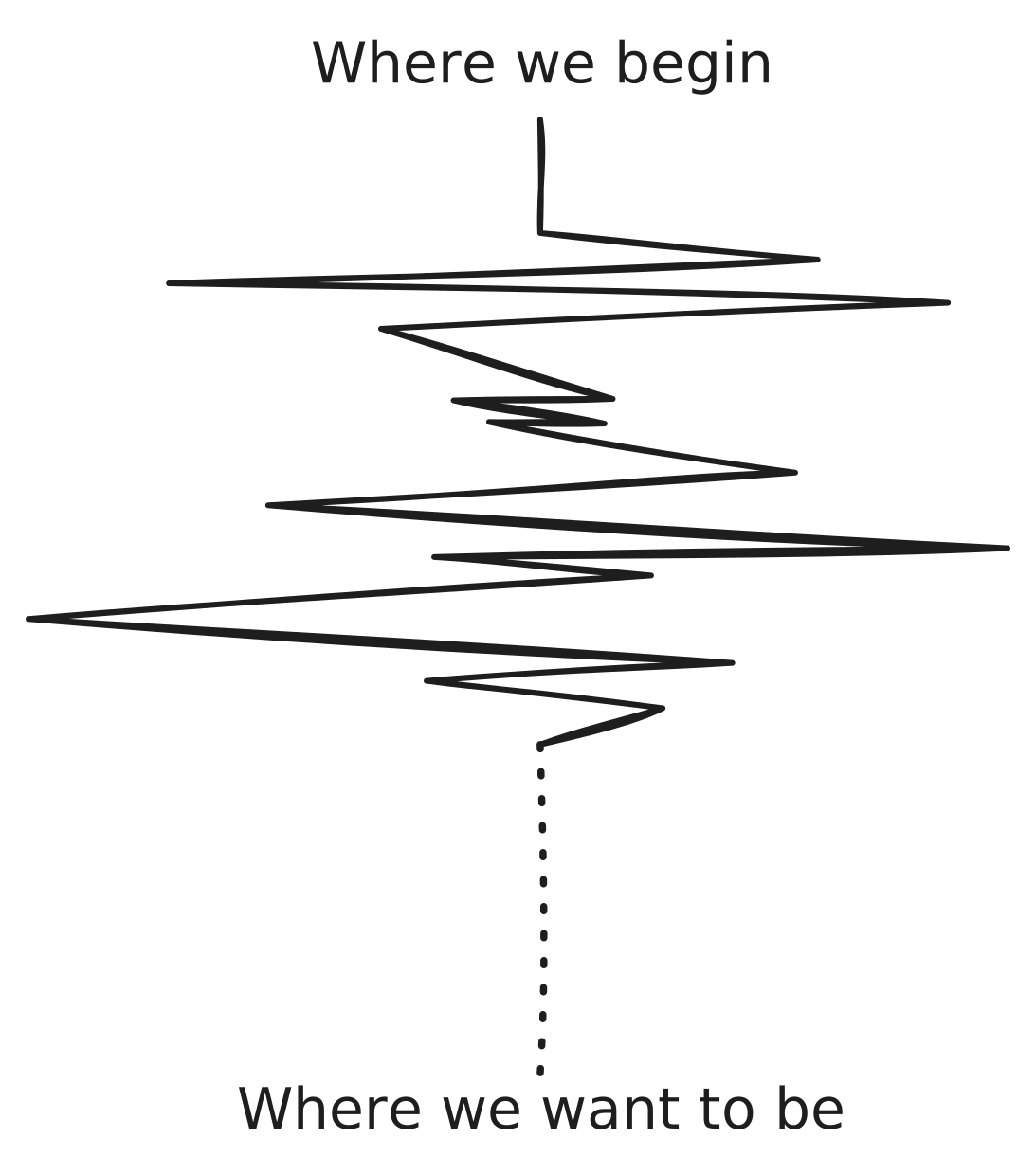
Software development rarely moves in straight lines. We overcorrect in one direction, learn from it, and swing back. Each swing gets us closer to equilibrium. The equilibrium point is discovered through iteration, not designed upfront. In one sense, we could consider this process like a multivariate search of the problem space for optimal solutions. We might sit at a local maximum for some time, but so often it is just that, and continued iteration brings us to yet more optimal solutions.
This lesson connects to the first: sometimes customer direction doesn’t align directly with our intended destination.
No matter the path, the hope is that we’re always overall getting closer to where we need to be. Even if we’re tacking around trying to catch the wind, we’re still moving forward.
Cirrus’s development is not short of examples of this lesson. Perhaps the biggest example was previously mentioned in the Part 1 post, specifically building then throwing away the project CLI, but I’ve compiled several more that I think illustrate this lesson, each in a different and valuable way.
Example 1: State database oscillations
Cirrus has always used DynamoDB for its state database. Even back in 2021, we felt DynamoDB imposed problematic limitations and conceived of a new design leveraging PostgreSQL. For reasons (see Lesson 1), we were never able to pursue this part of our plans.
Until SWOOP, where we did use PostgreSQL. We learned a lot from that experience, particularly around what it takes for PostgreSQL to accommodate the scale of our largest Cirrus deployments like Earth Search. That’s not extreme scale, but it’s still enough to require advanced techniques like table partitioning and explicit row locks/skips. And it worked well, but it definitely required more operational oversight and maintenance than Cirrus’s use of DynamoDB.
We’re still having this conversation today, five years later. Knowing what we know now and seeing what features we want to support, the lack of extensibility in the current Cirrus DynamoDB schema has become an impediment to new features. We’ve also leveled up on DynamoDB and see new ways to make it work better for the things we want to do. Now the conversation has shifted: we’re on the verge of a complete redesign of the state database, but we’re most likely going to stick with DynamoDB. At least for now.
Example 2: Workflow chaining regrets
In late 2021, we added a feature to Cirrus called “workflow chaining.” This addition was in response to a customer need (again, see Lesson 1) for an in-the-box way to have the output of one workflow flow into the input of another. Implementation of this feature was easy: a slight payload format change provided support for a single process definition, or an array of them in the case of chaining.
The last feature to land in Cirrus v0 is a thing called “workflow events”. This feature provides a new integration point for downstream systems and customizations that require a real-time view into Cirrus state, but also enables an alternate and more powerful pattern for chaining. Feeder lambdas can be subscribed to success events as a way to generate new payloads for additional processing, adding any custom business logic as necessary.
Looking back, I’ve started questioning if my gusto to quickly implement chaining might have been a mistake. Not because it doesn’t work—it does, and it certainly seemed to work quite elegantly at the time—but having that feature likely meant that we didn’t seek more flexible solutions until much later. Now that workflow events exist, should we remove chaining? Maybe. Chaining is simpler where it works, but the simple in-the-box functionality is trivially replicated with a single lambda subscribed to the workflow event stream.
Sometimes easy solutions can delay finding better ones. Or, perhaps sometimes, the pendulum settles at equilibrium with multiple valid solutions. Built-in chaining works great for straightforward pipelines. The pub/sub pattern offers more flexibility: conditional logic, transformations, fan-in, decoupling. Both have their place. The right abstraction at a higher level doesn’t necessarily obsolete the lower-level feature; sometimes they complement each other.
Example 3: IaC Coupling
In the beginning, Cirrus was tightly coupled to Serverless Framework. The project CLI tightened that coupling significantly. This ended up being a problem, as we saw. The v1 rework, in response, completely decoupled Cirrus from IaC, at least in the core project.
Except we realized that we’d overcorrected. With the v1 culling of Serverless we lost all core resource definitions. Sure, we package the lambdas up into a zip, but they are useless without knowing the SNS topics, SQS queues, IAM roles, and DynamoDB table schema they require.
Recently, we added a minimal CloudFormation template back into the core repo as the reference implementation. This has three effects:
- We can use that minimal template for development testing
- We have a source of truth for what the Cirrus core minimally requires (that isn’t embedded deep within our highly-opinionated Terraform module)
- Changes to that template are an effective way to communicate what resource changes need to be made to use new features or be compatible with new releases
This journey has been about finding the right level of coupling. How do projects provide cloud resource definitions without IaC lock-in? Our answer: use the vendor’s IaC solution (CloudFormation), since Cirrus is AWS-specific anyway. This answer is not particularly satisfying, but it’s the best one we’ve figured out so far. (This whole problem seems to be one without a great solution—but please let me know if you know of something I don’t!)
The broader pattern
Each of these examples shows how the pendulum swings: back and forth, in many dimensions, all the time. We should embrace the swing: it’s not failure or weakness to say a past decision was bad, or that you’ve changed your mind. The swing, rather, is a key mechanism for learning and growth. It’s how we get better.
Embrace the swing. Recognize the swing is inevitable. Plan for it, or even better, use it to your advantage. Pendulums have momentum: harness it.
Lesson 3: The vision remains unchanged
For Cirrus, the vision can be summarized in three words: “failures are inevitable.”
A lot is packed into those three words.
When reprocessing the Sentinel-2 catalog and its roughly 40 million scenes, failure will happen. At that scale, it’ll probably happen a lot.
Failure can happen in a workflow for many reasons. Service timeouts. API rate limits. Malformed metadata. Unhandled edge cases. Corrupted files. Network issues. Missed bugs. Extended Wednesday-morning maintenance windows (if you know, you know). The list goes on.
The vision that’s remained constant through all of Cirrus’s evolution—from Cumulus in 2017 to today—is designing a system where failures at scale are manageable. This means:
- Failures need to be cheap. State tracking makes retries inexpensive. Send in all the payloads again: items that previously succeeded get skipped automatically, only failures re-run. Don’t pay to reprocess what’s already done.
- Failures need to be visible. The state database and event logs let operators query, “What failed?” “Why did it fail?” “How often is this workflow failing?” You can’t fix what you can’t see.
- Failures need to be easy to resolve. Replay a workflow execution. Update the task logic and resubmit the payloads. Redrive payloads in a dead-letter queue. The system shouldn’t make recovery harder than the failure itself.
This isn’t just philosophy; we must make it reality. The architecture enables iteration: process a million items, fix the failures, move on.
We haven’t always excelled at realizing this vision, or even articulating it so concretely. But we’ve always had a sense of what it was, and always kept it in mind. The vision ensures that as we meander along the path, we know we’re still headed, however vaguely, in the right direction.
The broader message: every major project should set aside time to identify its vision, those basic principles that cannot be compromised without compromising the project itself. Doing so establishes the project’s north star: the fixed reference that contributors can always fall back to when determining if something is valuable or in scope. Such principles are critical insurance against bloat, ill-conceived features, and technical debt. Many things can risk a project’s continued success, so a strong vision is a core mitigation against that risk.

Reflection
Cirrus has been an active project for over five years, and a concept for more than eight. We’ve invested a not insignificant amount of time building it out to what it is today, and have used it as a foundational component for a number of customer and internal projects, including as the data orchestration framework for our public Earth Search catalog. Cirrus is a key technology that enables us to develop these projects efficiently and effectively. Reflecting on how we’ve then developed Cirrus is all the more interesting given its importance in our work.
To recap, the three lessons I found from my experience working on Cirrus are:
- Follow the money: understand the motivations of those who are providing the resources for developement
- The pendulum is real: development is inevitably something of a random walk searching a problem space for an optimal solution
- The vision remains unchanged: know the core principles guiding a project and do not compromise them
As you navigate your own journey, whether that’s in open source geospatial development like me or something else entirely, I encourage taking time to document where you’ve been and where you’re headed. Reflect on what you’ve learned. Do these three lessons apply to your projects? What other lessons emerge from your experience? I’d be interested to hear what others discover in their own retrospectives.