This post is based on the author’s talk (Re)Making Cirrus: Five Years Building a Data Orchestration Framework, presented at FOSS4 NA 2025 and FOSS4G 2025.
We’ve remade Cirrus at least three times. Maybe four, depending on how you count.
Cirrus, a data orchestration framework we develop and use here at Element 84, recently celebrated its five-year anniversary of being open-sourced. Despite being a critical component of our infrastructure, we haven’t discussed it much publicly. Given the years we’ve spent building Cirrus, it seems like we’re well past the time to write about it. And, because we’ve been working on it for so long now and this isn’t just a write-up on a new thing, it felt like the right thing to do was to take a retrospective look at Cirrus’ history and where we plan to go from here.
What is Cirrus?
Cirrus is the data orchestration component of Element 84’s FilmDrop suite of open source tools for building geospatial data lakes. FilmDrop combines projects we maintain—like Cirrus, of course, and stac-server—with other community open source projects to provide an end-to-end solution for data providers and processors. We use Cirrus to orchestrate data processing, with a key focus on building metadata for said data, enabling indexing for search and discovery.
Cirrus supports many of our projects at a wide range of scales. From tiny projects, maybe processing a few hundred images a year, to massive scale processing tens of thousands of items a day for catalogs of many millions of items, sometimes with historical processing bursts to over one hundred thousand items per hour! Cirrus has proven effective and efficient at both ends of the spectrum.
Costs also scale well, approaching zero at idle. The design allows users to select the smallest viable compute for any given task, helping to keep costs down even under load. The system is relatively easy to use—though I recognize my bias in saying so—and learning it isn’t much more than learning the handful of AWS services it leverages. Like any technology, users need to understand some specific concepts to “get it”, but the entry-level barrier is low, and most complexity tends to be a function of user-defined workflows rather than the system itself.
The core system is simple and opinionated, which makes it easy to get started quickly, while remaining flexible enough to accommodate advanced needs with minor configuration. It’s also extensible, so truly advanced use-cases can build custom systems around the core infrastructure to handle even more complex or stateful workloads.
With that conceptual introduction out of the way, let’s jump into Cirrus’s history. We’ll dive deeper into the technical details of Cirrus as we go along.
The evolution of Cirrus
To better understand Cirrus, it helps to trace its evolution over the years.
2017: First, there was Cumulus
While Cirrus has been an open source project for five years, this story actually begins in 2017. That’s when Cumulus was first conceived by a handful of engineers from Development Seed and Element 84, who came together to design a new cloud-based event-driven orchestration solution for NASA’s DAACs. The system was designed to process data and generate metadata for NASA’s Common Metadata Repository (CMR). Among those who contributed to the original idea were Alireza Jazayeri, Patrick Quinn, Joe Flasher, and Matt Hanson.
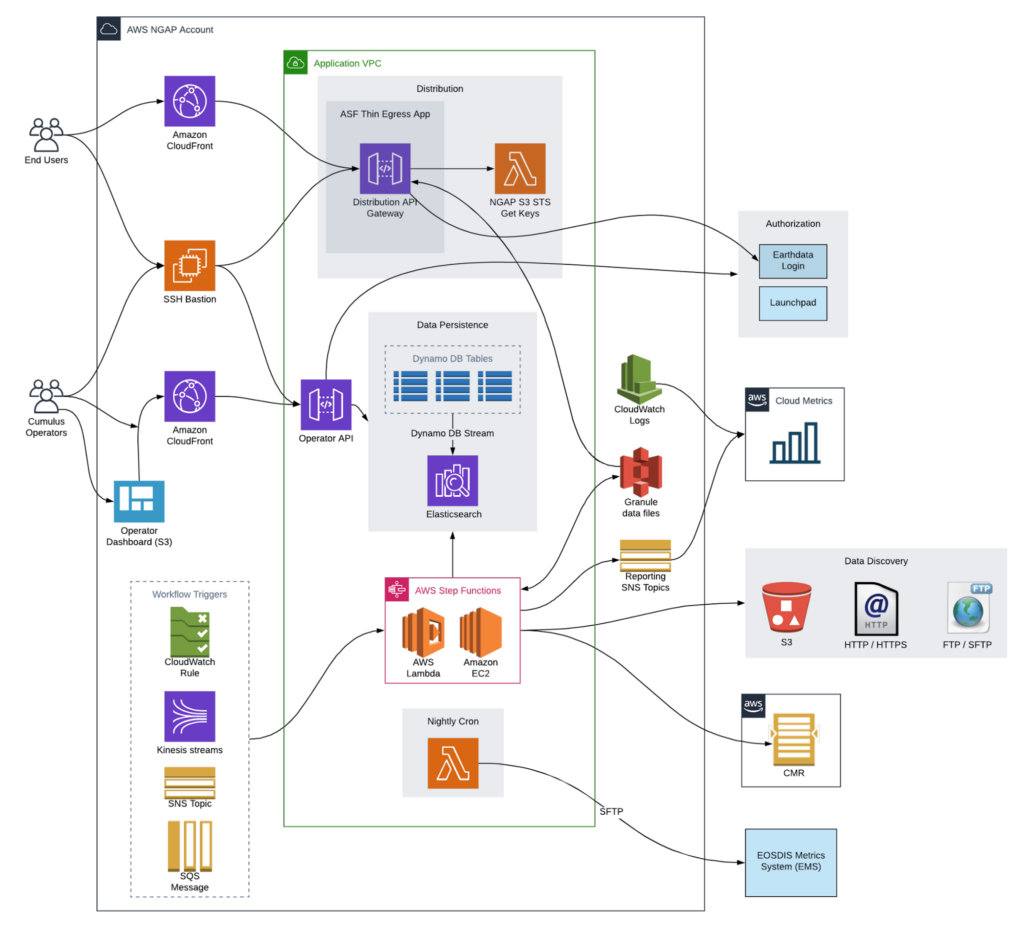
Cumulus Architecture Diagram
Cumulus aimed to be a simple solution. In some ways, given the multitude of legacy requirements it must meet to be viable across all the DAACs, it is. But those various requirements led to complexity that compromised key tenets of the original vision. That, combined with the design centered around CMR, means Cumulus is limited in its application outside NASA.
2019: Towards a lighter Cumulus
By 2019, Matt Hanson had joined Element 84, where he found himself involved with three projects needing a scalable data orchestration solution. Scale was the operative word: one project for an early-stage commercial SAR provider had low, but growing, data volumes with significant compute requirements. Another project required back-processing the entire Sentinel-2 archive into cloud-optimized GeoTIFFs and forward-processing all new Sentinel-2 data in near real time.
This latter project ultimately formed the foundation for what is now our Earth Search data catalog, which we orchestrate entirely with Cirrus. At time of writing, the Earth Search v1 deployment processes some 30-some-thousand scenes a day into a catalog of around 77 million STAC items backed by over 30 petabytes of data assets.
STAC, that’s a key concept here worth emphasizing. In 2019, STAC—an effort that had also started in 2017—was rapidly developing. Not just into a viable metadata specification, but into an entire ecosystem of tooling. In retrospect, STAC was a key piece missing from the design of Cumulus, which was tightly coupled to NASA’s CMR and its metadata format. Recognizing the value of STAC, and seeing that Cumulus had diverged from the lightweight architecture originally envisioned, Matt decided to build a new data orchestrator around his concept of STAC Workflows, calling it “Cirrus”, because it is a lighter Cumulus.
STAC Workflows
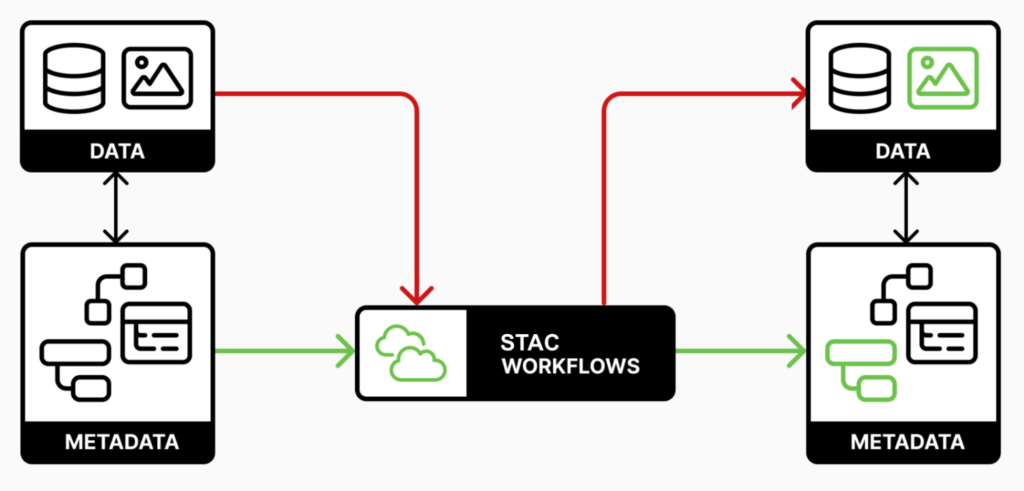
STAC Workflows emphasizes that payloads in and out of processing tasks and workflows should leverage STAC as a stateful messaging format. That is, instead of putting various bits of processing state in a central database or the like and passing around opaque links to data files, use STAC metadata to track the processing state. STAC inherently includes both the state—what items exist, what assets they have, what properties have been enriched–and data pointers (via asset HREFs), and allows messages between processes to themselves track the state of the system, all using a standardized metadata format with a vibrant open source ecosystem of compatible tooling.
STAC Workflows matter because:
- Workflows become composable: The output of one workflow can be the input to another. Chain them together naturally.
- Processing becomes metadata-driven: If you can search for it in a STAC catalog, you can process it. Query for “all Sentinel-2 scenes from last week” and kick off processing for each result.
- Debugging becomes simpler: Messages between processes carry the state. No need to correlate database records with log files—the metadata tells you exactly what was processed and when.
- They leverage the STAC ecosystem: Tasks can use standardized STAC tooling—pystac for reading and writing Items, stac-task to handle processing boilerplate, and various other stac-utils packages that provide a whole collection of building blocks for STAC-related work.
2020: Cirrus open sourced
Development of Cirrus started in private, but it was released to the public in 2020, under the Apache 2.0 open source license.
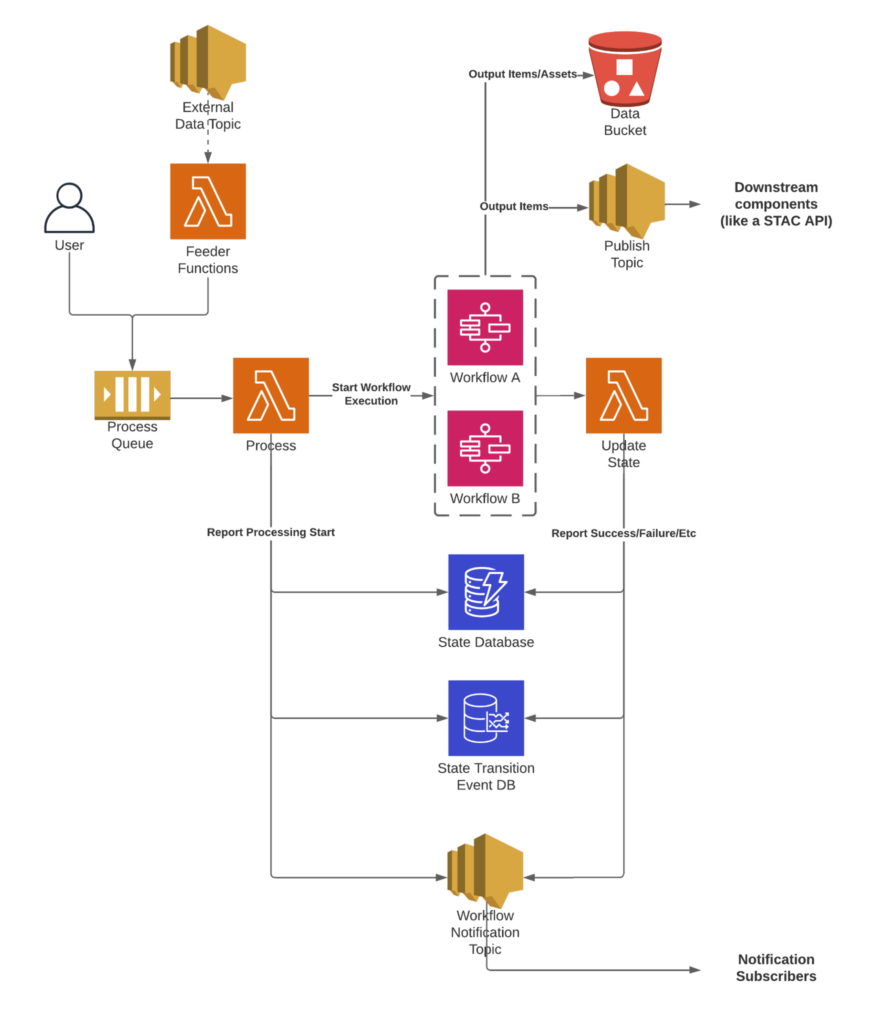
Cirrus System Architecture
Cirrus was, and remains, quite lightweight: the core components are two AWS Lambda functions, Process and Update State, that manage system state in a DynamoDB table. Around them we have an input SQS queue—where users enqueue payloads to be processed—and published items and workflow event flow to output SNS topics. Workflows are orchestrated via AWS Step Functions, and tasks within those workflows generally leverage either AWS Lambda or AWS Batch for compute.
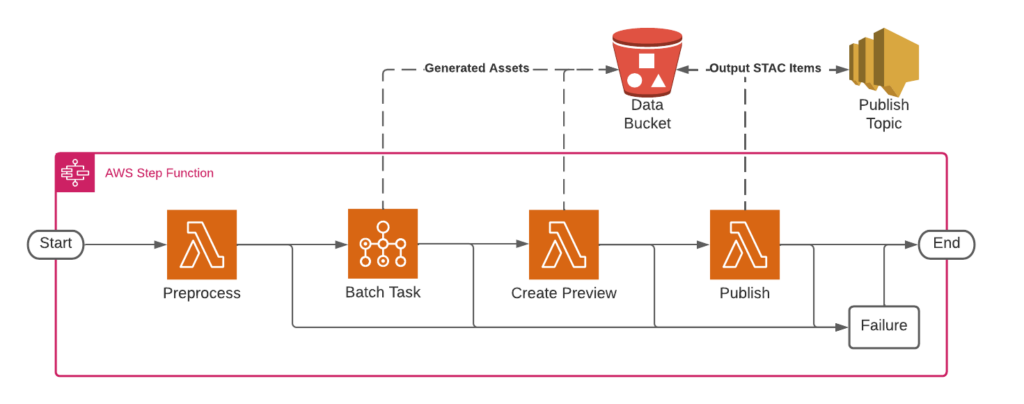
Example Cirrus Workflow
How all this works
This seems a good time to interject with a deeper dive into the Cirrus architecture. For the sake of simplicity, we’ll look at the system as it exists today, which does have some differences from Cirrus as it was in 2020.
Feeders are anything that builds and sends payloads into the system. Typically they trigger off an event for new data. This could be a Lambda function triggered by new files appearing in S3, or messages published to an SNS topic representing new data. Feeders publish payloads to the process queue (SQS), which provides buffering to allow millions of payloads to be enqueued and processed as capacity/rate limits allow (like the fact that only one million step function executions can be running simultaneously in one account, a limit we have hit on more than one occurrence 😁).
The Process Lambda picks payloads off the queue and checks the state database to see if it has processed this payload before. If it was previously processed successfully, it’s skipped. This check makes it easy and cheap to address failures by rerunning batches of payloads without having to worry about reprocessing successful ones. For new or failed payloads, Process looks at the workflow specified in the payload and starts the corresponding Workflow execution.
Workflows, as previously mentioned, are AWS Step Functions state machines, where each processing step is a STAC Workflows Task. Tasks are executed as a Lambda function or AWS Batch job, depending on resource needs: Lambda is easier to manage, cheap, and fast, but unsuitable for long-running or resource-intensive processing; Batch has a higher operational complexity, but allows for indefinite processing and/or the specification of specialized compute resources (large disks, more memory, GPU processing, etc). Convert to COG. Generate a thumbnail. Calculate statistics. Each Task enriches or modifies the metadata based on the processing result(s), and passes the metadata along to the next step.
The Amazon States Language leveraged by Step Functions allows for complex and expressive retry logic and error handling. It also provides a number of useful non-processing step primitives, including control flow steps like the Choice, Map, and Parallel states.
Parallelism in Cirrus can then be implemented in two ways: within a given workflow using the Map or Parallel states, or at the workflow level by running many separate executions in parallel. Each has its advantages, but we typically recommend keeping executions as one-to-one with product generation as possible. That is, for each product to be generated, it’s generally (but not always) best practice to have a single workflow per product, and to have each workflow execution generate one Item of that product type.
Why? Because of Cirrus’s state tracking. Keeping the processing in a given workflow execution confined to a single product means that failure has the smallest impact surface, and reprocessing can be as granular as possible.
State tracking happens across two databases: a DynamoDB table tracks workflow execution status (“what’s running?” or “what failed?”) and various other payload/execution details, while a timeseries database logs state changes to provide operational metrics and help with debugging.
Cirrus produces messages for consumers via two SNS topics: the Workflow Event topic and the Publish topic. These topics provide extension points by which to integrate other components, in a loosely-coupled manner. All state transitions and other events are emitted from the system as messages via the Workflow Event SNS topic, which can be used to allow external systems to track the processing of certain items or to facilitate more complex integrations. All output STAC items are published by Cirrus to the Publish topic for downstream systems, like a STAC API ingest function.
It is a simple but robust and featureful system.
The original distribution
All of this was distributed, originally, as a single project directory downloaded as a zip file from the GitHub repo. It leveraged Serverless Framework as an infrastructure-as-code (IaC) solution. Users would download and extract the zip file to create a new project, then add their own code and resources directly into the Serverless project, sometimes modifying the core code to fix bugs or make customizations.
An open source Python library called cirrus-lib was also released at the time to help Task authors. This packaged up a number of helper functions and convenience classes to make it easier to write Tasks in Python.
2021: The Cirrus Project Model
The copy-the-directory-around model worked well initially, and was, admittedly, a pragmatic solution for proving out the idea across various projects (there’s a valuable takeaway here that I think lives somewhere between JFDI (Just Freakin’ Do It) and the saying “perfect is the enemy of good”). That said, it had a significant flaw: projects struggled to track which parts of the codebase were proprietary versus core, as everyone had their own copy of everything and struggled to untangle owned vs upstream code. Bug fixes and features frequently failed to be committed back to the open source repo, and even when they were, projects couldn’t easily integrate the changes.
This was the situation when I started working on Cirrus development. My education is in geography and geospatial, but I’d spent the prior seven years in network engineering and network software development. When I joined Element 84 in 2021, I was immediately tasked with untangling project code from core code. I didn’t have the full context, but that didn’t stop me. For better or worse, I thought, “Great, I can fix this!”
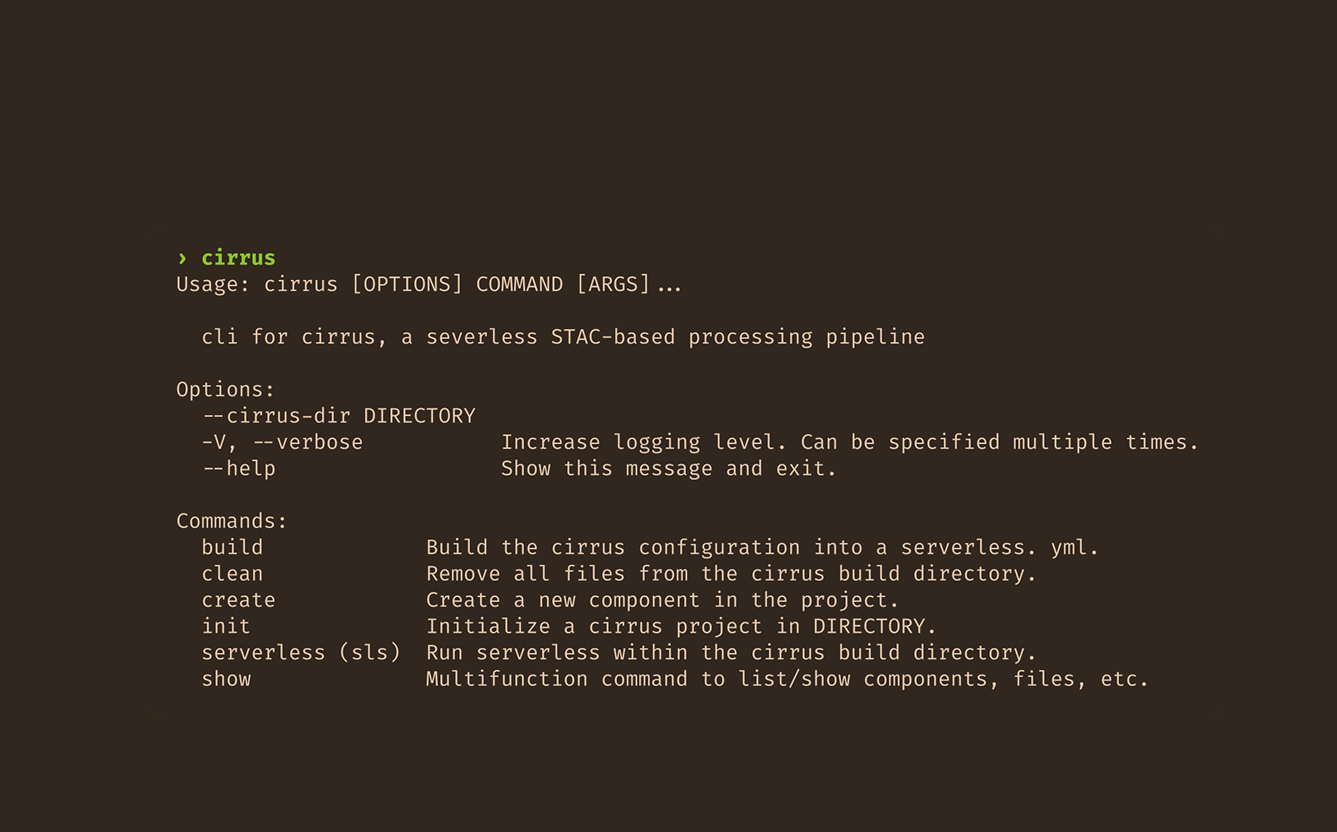
Having built numerous custom network configuration and troubleshooting tools in prior years, CLI development was familiar territory. Maybe it’d be called a bias–maybe some would say I had a hammer, so Cirrus was obviously a nail. In any case, I did what I knew. I made Cirrus into a CLI, roughly inspired by git: make a directory, initialize a project inside it by creating some state the tooling can reference, and voila! The CLI can support project-specific commands.
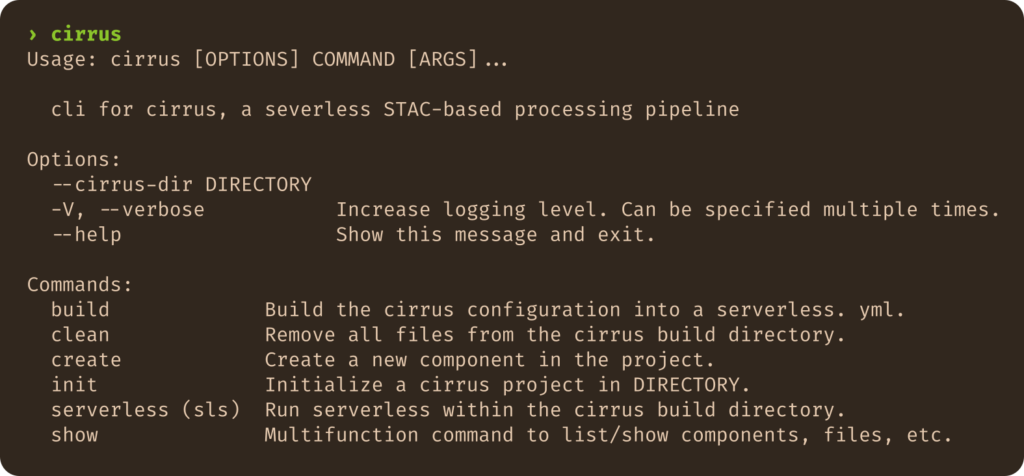
This approach effectively solved the immediate need: the built-in code and resources were packaged into a Python tool, and project-specific config and code lived in the project alone. But it propagated—indeed, doubled down on—the coupling to Serverless Framework. The entire structure of a project, all the configurations, and all the CLI code were entirely dependent on Serverless.
2022 to 2024: Continued iteration
Over the next couple of years, the project CLI approach worked well. We were able to focus development on bug fixes and operational improvements to increase system stability. We made good progress on documentation, covering most topics end users needed to get started with and understand Cirrus. We built a plugin system for the CLI to enable add-on functionality, including a project documentation build tool and a management CLI for interacting with and operating Cirrus deployments. We added observability features, including time series metrics and event notifications. We also handled the Serverless v2 to v3 upgrade and migration.
Also during this time we deprecated cirrus-lib, replacing it with a Python library called stac-task. This library aimed to both simplify Task authorship through a new set of abstractions that further minimized Task boilerplate, and to create a non-Cirrus-specific library to support authoring STAC Workflows Tasks. This decoupling of STAC Workflows from Cirrus was decidedly intentional, driven by the realization that Cirrus was just one implementation of that broader concept.
A detour into SWOOP
During this timeframe, we also detoured significantly into SWOOP: the STAC Workflow Open Orchestration Platform. This was an experiment in reimagining Cirrus as a cloud-agnostic “meta-orchestrator”. Instead of DynamoDB, SWOOP used PostgreSQL for state storage, with an API built around the OGC Processes API specification. We implemented two backend components in Go that integrated the system with Argo Workflows on Kubernetes as the first supported workflow orchestration solution.
The motivation behind SWOOP was two-fold: address Cirrus’s pain points, and make a solution that didn’t require AWS. Per the latter, we had funding with the requirement that we target Kubernetes, which drove a number implementation decisions, such as the integration with Argo Workflows. That said, throughout the project, an overarching goal was to build a solution that would support pluggable orchestration backends, to allow future support for workflow orchestration via Step Functions on AWS, Logic Apps on Azure, or other self-hosted solutions like Prefect or Airtable.
An experimental exploration, now on pause
At this point I struggle to classify SWOOP’s status; to me it isn’t deprecated nor abandoned. I’m still invested in the idea. We completed a proof-of-concept. We successfully processed data. But funding ran out before we could close the gaps on production readiness. Maybe it’s best labeled as an experiment, one I hope to resume at some point. But for now SWOOP is on pause, waiting for a patron to support its completion.
Meanwhile, Cirrus couldn’t be retired. One can’t replace a production solution with something that isn’t production-ready, no matter how promising (though we all know that doesn’t stop organizations from trying now and again). Cirrus has had to continue on.
What SWOOP taught us
At the time, the shelving of SWOOP was disappointing. But reflecting on events now, the disappointment is tinted positively with the realization that SWOOP was, in effect, a rare reconnaissance mission. We got to try a bunch of crazy ideas. We got to do the fabled greenfield rewrite. We experimented with new and different technologies. We challenged our assumptions and questioned our beliefs. The experience provided valuable insights not just for SWOOP, but also for Cirrus. Ideas that spun out of that project have driven the development of some recent Cirrus features, and continue to guide the Cirrus roadmap in a variety of ways.
2025: version 1.0.0!
In 2025, we achieved a significant milestone with Cirrus: we got to a version 1.0.0 release! Two major factors led to calling this v1.0.0:
- We had been working on this long enough that we had tackled all the known significant bugs in the system, and gotten it to a reliable and robust state.
- We stripped all of the CLI and Serverless from the core project!
The latter was a massive change.
The backstory: in 2024 Serverless v4 was announced, bringing with it a significant licensing change and shift to a paid usage model. Serverless v3, the last open source release, was only to be supported through the year’s end. This situation was untenable: we couldn’t have an open-source solution dependent on a closed-source build tool. In April 2024, we drafted the plan to remove Serverless and reach a Cirrus v1 release. A month later, the initial PR for the rework was up for review, with a net 4,400 lines deleted from the repo.
The entire project-based CLI was gone. Everything Serverless was deleted. We decided to remove all the IaC configuration from the repo entirely, making the project “bring-your-own-IaC”. The core code left was just the central set of Lambda functions, now built into a single zip file for distribution.
We still needed a way to manage deployments via an IaC solution, so we created a Cirrus module in our FilmDrop Terraform modules repo to replace Serverless’ functionality. The Terraform module development and testing led to bugfixes and other improvements making their way back into Cirrus.
Finally, on February 28, 2025, we released version 1.0.0.
What’s next for Cirrus
We’ve been busy since the version 1.0.0 release, and continue to make improvements and targeted features. A few of the highlights:
- New management CLI commands: we still have a Cirrus CLI, but it is now specifically focused on operational needs. Originally a plugin for the project CLI, the management CLI continues to increase in functionality as we make common operational tasks more conveniently supported.
- Runtime optimizations: we’ve done a fair bit of work profiling the performance of the core lambda functions and have made improvements to reduce both cold and warm start times.
- Entirely new time series solution: AWS deprecated the original Amazon Timestream service last year, and made it unavailable for new accounts. We’ve since implemented a solution leveraging CloudWatch Log Insights as a cost-effective replacement requiring no additional or complex infrastructure.
Looking forward, we are discussing some potentially large changes. Ideas include a complete rework of the DynamoDB state database to enable tracking more aspects of the pipeline with a more robust data model, a rearchitecture of the systems event handling via a simpler, more extensible and modular architecture, continued core lambda performance optimizations, and even some major efforts like redesigning the payload message format or creating a code-based SDK to allow for modular and reusable code-based components declaring a project architecture.
Try it for yourself
So, that’s Cirrus, and the journey we’ve taken to make it what it is today. As an open source project freely available on GitHub anyone can take a look at the code, run it themselves, and even get involved and contribute back to it. If you are interested in running Cirrus yourself, learning from our mistakes, or simply just want to see what we’ve done, go dive into the repo. I’m always happy to hear from anyone using Cirrus or to answer any questions that arise, so please reach out and let me know what you think! And stay tuned for the upcoming part 2 of this post, where I’ll reflect on this history to pull out three core lessons from the Cirrus experience we’ve found useful to consider in our other work.